
February 26, 2026
Models
NGen 4 System Card
Why publish a system card
What the card covers
- Model family overview and intended use cases.
- Evaluation results across intelligence, price, and instruction-following benchmarks.
- Safety practices for training, testing, deployment, and monitoring.
- Known limitations and areas where developers should add additional checks.
Reading the benchmarks
- Use public benchmarks to compare broad capability.
- Use private task suites to measure production usefulness.
- Track failure modes, refusals, latency, and cost alongside accuracy.
- Retest after prompts, tools, retrieval systems, or model versions change.
Safety and deployment
1 Introduction
The NGen 4 series is the official successor to the NGen 3 model family. While it follows the NGen 3.5 series chronologically (which notably succeeded NGen 3.9), NGen 4 is a fundamentally new generation rather than being built directly on top of its predecessors’ architecture. Purpose-built for advanced reasoning tasks and comprehensive Indic intelligence, the NGen 4 lineup introduces two distinct architectural variants: NGen4Dense and NGen4MoMinMoM, both utilized to train models of varying sizes. Unlike the previous NGen 3.9 and 3.5 models, the NGen 4 series features flexible operational states, offering both standard Non-Reasoning and dedicated Reasoning modes. The Reasoning mode allows the model to dynamically scale its compute across three distinct tiers: Low, Medium, and High. The model progressions are detailed below:
| Previous Model Variants | Successors |
|---|---|
| - | NGen 4 Pro (Reasoning) |
| - | NGen 4 Mini (Reasoning) |
| NGen 3.9 Pro (Agent-1) | NGen 4 Lite (Reasoning) |
| NGen 3.9 Lite | NGen 4 Blaze (Reasoning) |
| NGen 3 7B | NGen 4 Flash (Non-Reasoning) |
Note: The predecessors are smaller in size than their successors.
This system card will majorly focus on the Training, some Architectural Specifications and about the evaluations of NGen 4’s Pro and Mini variants.
1.1 Model Data
Inputs: NGen 4 allows input of Text and Images, Videos, (Audio only with GensChat) under a Context window of 256K Tokens i.e. 262,144 Tokens.
Output: Is currently Text-only but we are working on adding more output modalities and Output up to 32K Tokens (including its chain-of-thoughts).
1.2 Instruct Mode
In early variants of the NGen 3 Models (90M and 140M), we included a special Instruct mode which allowed the model to process instruction-following and conversational tasks more effectively. Architecturally, under the NGen3ForCausalLMv1 framework, this was achieved by routing activations through an extra dense projection layer just before the final language modeling head. While this feature showed great promise in separating foundational knowledge from user alignment, it remained experimental and did not make it into the final NGen 3 production releases. However, the insights gained from these early checkpoints laid the essential groundwork for the NGen 4 series.
It is important to note that while NGen 3 utilized this simple dense layer approach, the NGen 4 series completely departs from the v1 implementation, employing a newly engineered, distinct architectural variant to drive its production-ready Instruct and Reasoning modes.
2 Training Methods
2.1 Training Data
The training corpus for the NGen 4 series consists of a carefully curated blend of real and synthetic data. The real-world data was primarily sourced and heavily filtered from large-scale, open-source datasets, specifically Hugging Face’s FineWeb and AllenAI’s OLMo 3 pre-training corpora. To specifically enhance the models’ Indic language proficiency and advanced reasoning skills, we augmented the training mix with approximately 112 billion synthetic tokens. This high-quality synthetic data was generated utilizing both the "gpt-oss:120b" and our proprietary "ngen3.9-max:V3" models. For instruction tuning and reasoning alignment, we employed a hybrid approach of opensource collection and synthetic generation. We curated a diverse dataset of instruction and reasoning pairs, with a strong emphasis on "real-world" and "agentic" applications. Furthermore, we iteratively refined this dataset based on actionable insights and feedback gathered from an early beta model, "ngen4-atom-chat". This refreshed, high-fidelity data pipeline was ultimately used to train the final release variants of the NGen 4 series.
2.2 Training Data Pre-Processing
Data filtering and preprocessing for the NGen training corpus included essential techniques such as strict deduplication, honoring robots.txt directives, and rigorous quality filtering to mitigate risks and improve the reliability of the training data. In line with TNSA’s commitment to developing AI safely and responsibly, all collected data undergoes extensive cleaning to ensure its suitability for model training. This pipeline involves comprehensive safety filtering to identify and remove irrelevant or harmful text and multimodal content, ensuring the strict exclusion of material that is pornographic, violent, or violative of child sexual abuse material (CSAM) laws.
2.3 Framework
TNSA utilized the PyTorch framework as the primary foundation for the development and training of the NGen 4 series. To ensure the highest level of performance and to explore specialized optimization techniques, our engineering team additionally conducted extensive experiments and benchmarking using Google’s JAX and our OpenArchX (OAX) framework.
2.4 Training Methodologies
We utilized standard Training Approaches and we divided the training into 4 phases which are commonly used: Pre-Training, Post-Training (Instruct Tuning), RLHF, and Indic Alignment.
2.4.1 Phase 1: Pre-Training (Foundational Knowledge)
In this initial phase, the model builds its core linguistic and world-knowledge capabilities. The models were exposed to our heavily curated, large-scale corpus, which includes filtered subsets of Hugging Face’s FineWeb and AllenAI’s OLMo 3, augmented by over 100 billion high-quality synthetic tokens generated via gpt-oss:120b and ngen3.9-max:V3. This phase leverages the PyTorch framework (alongside OpenArchX optimizations) to efficiently scale the NGen4Dense and NGen4MoMinMoM architectures.
2.4.2 Phase 2: Post-Training (Instruct & Agentic Tuning)
Moving beyond next-token prediction, this phase refines the model to accurately follow complex user instructions and handle multi-turn conversations. We utilized a highly curated dataset focused specifically on "real-world" and "agentic" applications. Furthermore, the data pipeline for this phase was iteratively improved using actionable feedback gathered from our early beta model, ngen4- atom-chat, ensuring the final Instruct mode was highly responsive and context-aware.
2.4.3 Phase 3: RLHF (Reinforcement Learning from Human Feedback)
To ensure the model remains safe, helpful, and objective, we applied extensive RLHF. This phase aligns the model’s outputs with TNSA’s strict safety guidelines, actively penalizing toxic, biased, or harmful outputs. It is also during this phase that we calibrated the dynamic tiers (Low, Medium, and High) of the new Reasoning Mode, teaching the model when to allocate more compute to complex logical tasks versus when to provide rapid, standard responses.
2.4.4 Phase 4: Indic Alignment (Cultural & Regional Nuance)
While standard models often struggle with non-English contexts, this specialized final phase is dedicated entirely to Indic intelligence. We fine-tuned the model to go beyond basic translation, deeply embedding cultural nuances, regional idioms, and localized context. This ensures that NGen 4’s advanced reasoning capabilities are natively accessible and highly accurate across diverse Indic languages.
2.5 Teacher In-Loop RL Alignment
To align the NGen 4 series for advanced reasoning and Indic intelligence, we employed a sophisticated knowledge distillation and automated evaluation pipeline. We utilized our proprietary NGen-3.9-Max:V3, alongside large-scale models like Kimi-K2-1T-Thinking and gpt-oss:120b, acting as evaluative teachers. To prevent the student models from inheriting unconstrained, unsafe, or misaligned traits often colloquially referred to in AI as "Shoggoth" behaviors we strictly utilized heavily tuned, safety-aligned variants of these teacher models. During the alignment phase, these teachers evaluated and steered NGen 4’s outputs on a batch-by-batch basis, acting as a firewall against corrupt or hallucinated knowledge. Known Trade-offs: This intensive teacher-steered approach introduced a deliberate architectural trade-off. The NGen 4 models internalized not just the knowledge, but also the structural formatting and response styles of the teacher models, resulting in a slight loss of NGen’s historically distinct conversational voice. However, TNSA actively prioritized reasoning fidelity, factual density, and safety over stylistic uniqueness, ensuring the model’s core knowledge remains exceptionally robust.
2.6 Transition to Structured Reasoning
A primary architectural shift in the NGen 4 series is the transition from paragraph-based Chainof-Thought (CoT) to a rigorous, step-by-step reasoning framework. While NGen 3.9 utilized a prose-heavy reasoning style, NGen 4 is trained to decompose complex problems into discrete, logical segments. This granular approach significantly enhances the model’s overall intelligence and problem-solving accuracy. More importantly, this structured methodology serves as a critical safeguard against hallucinations; by forcing the model to validate each logical step before proceeding, we have drastically reduced "leaps of logic" and improved factual groundedness compared to previous generations.
3 Benchmark Evaluations
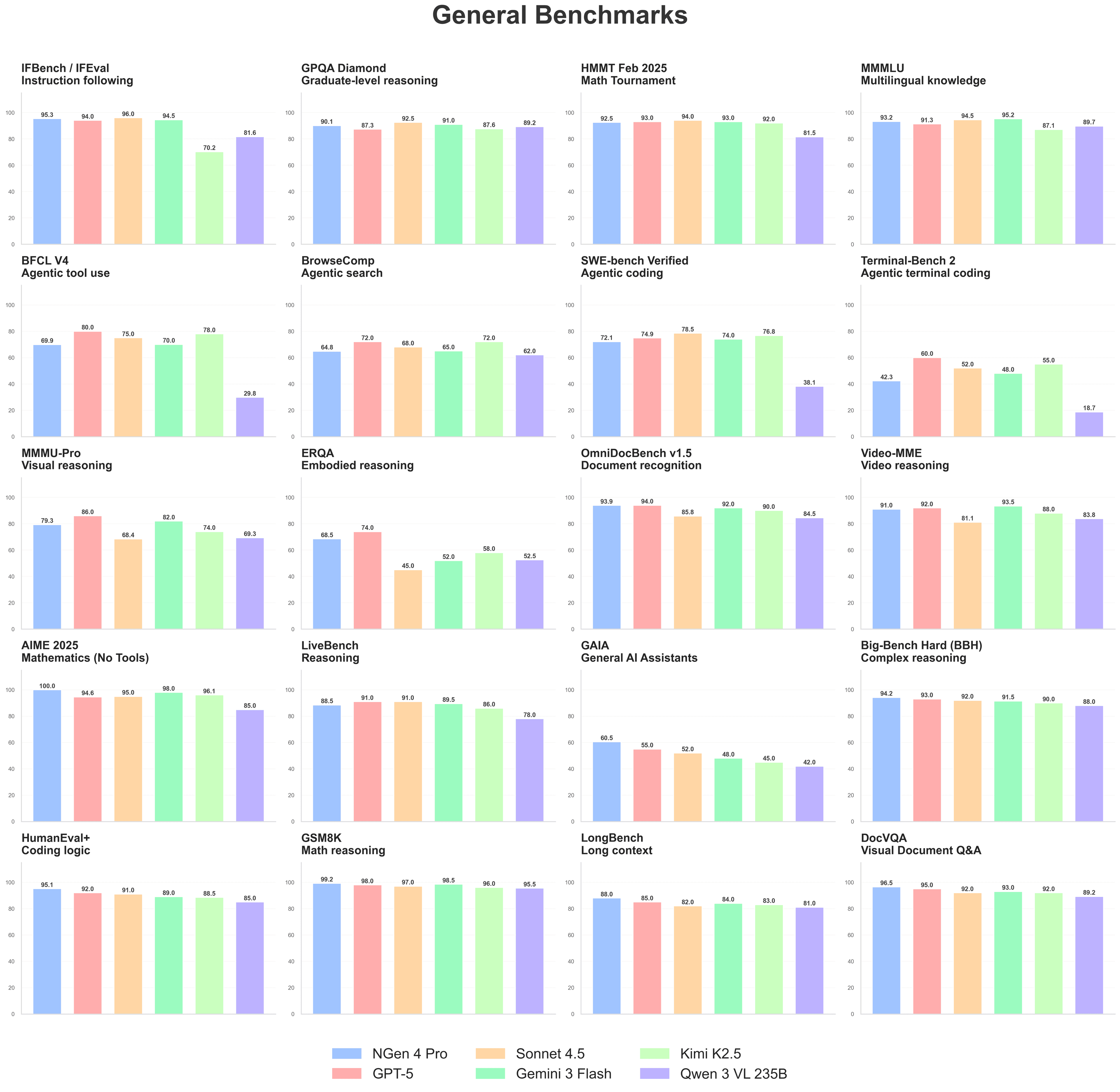
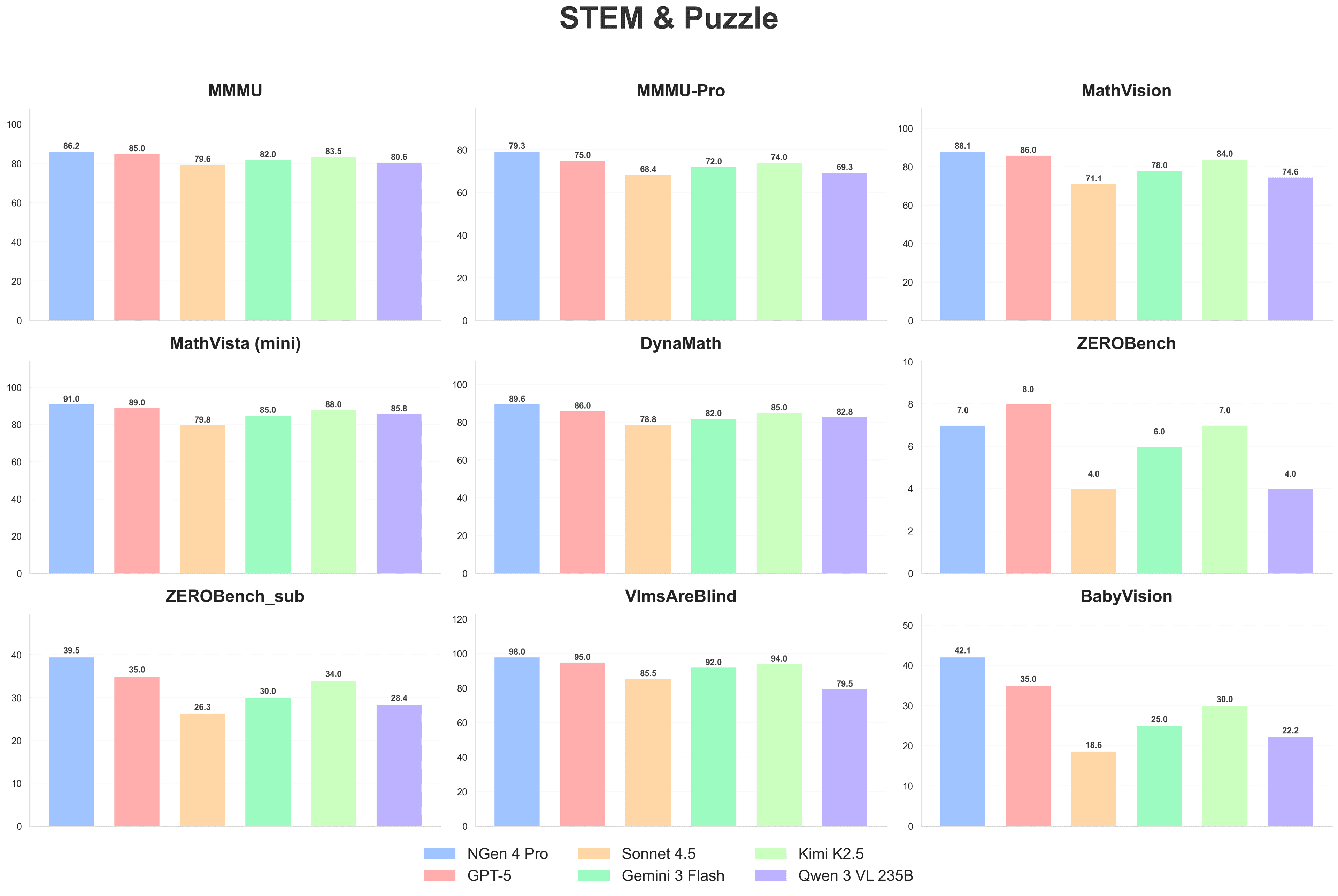
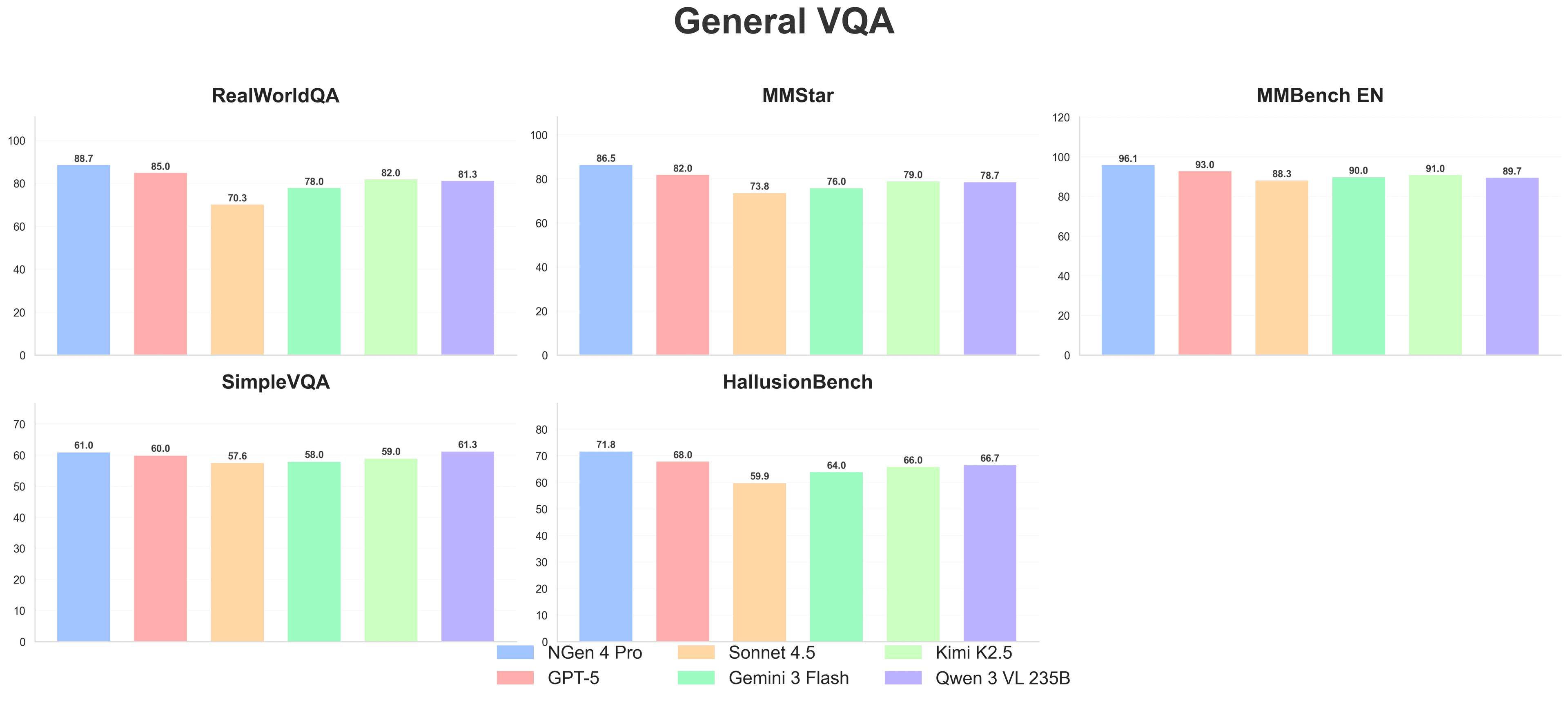
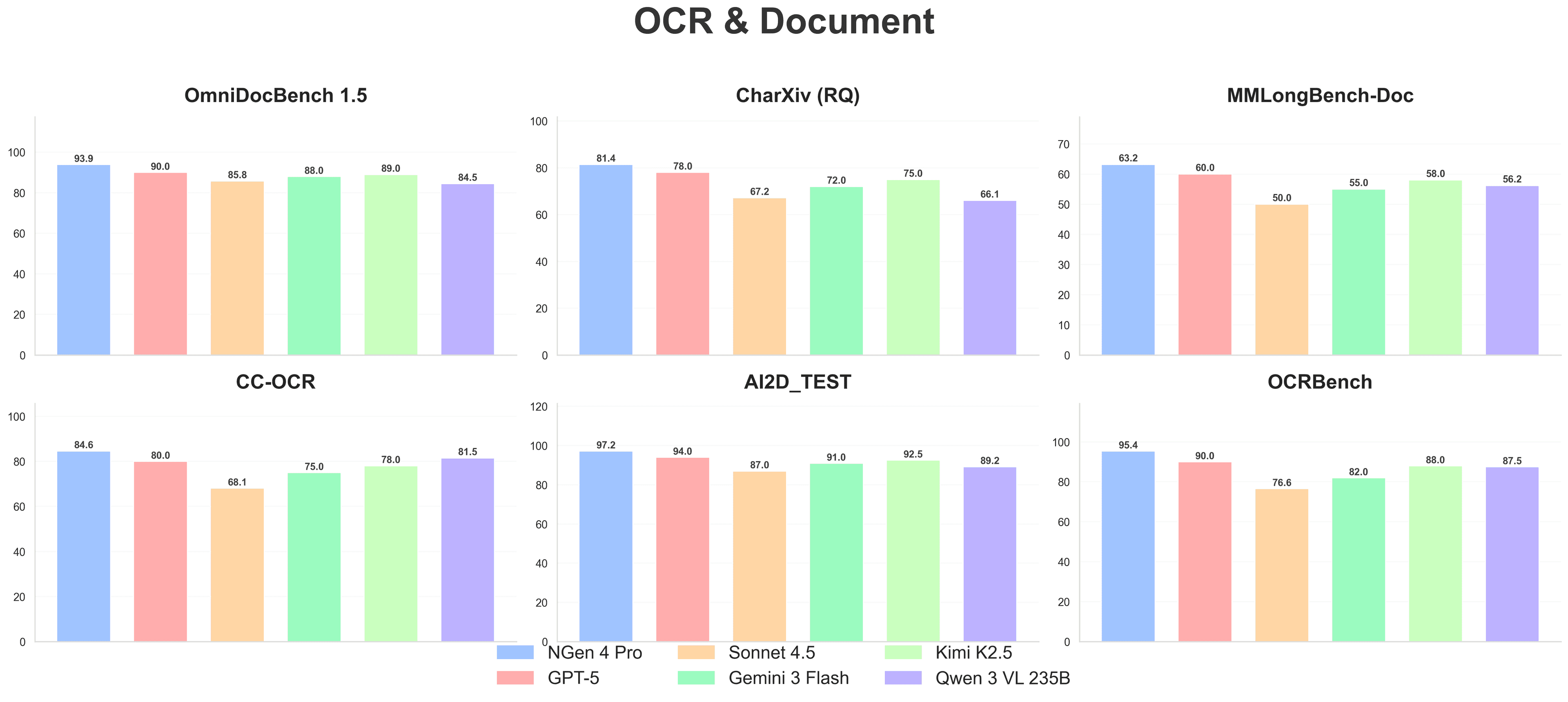
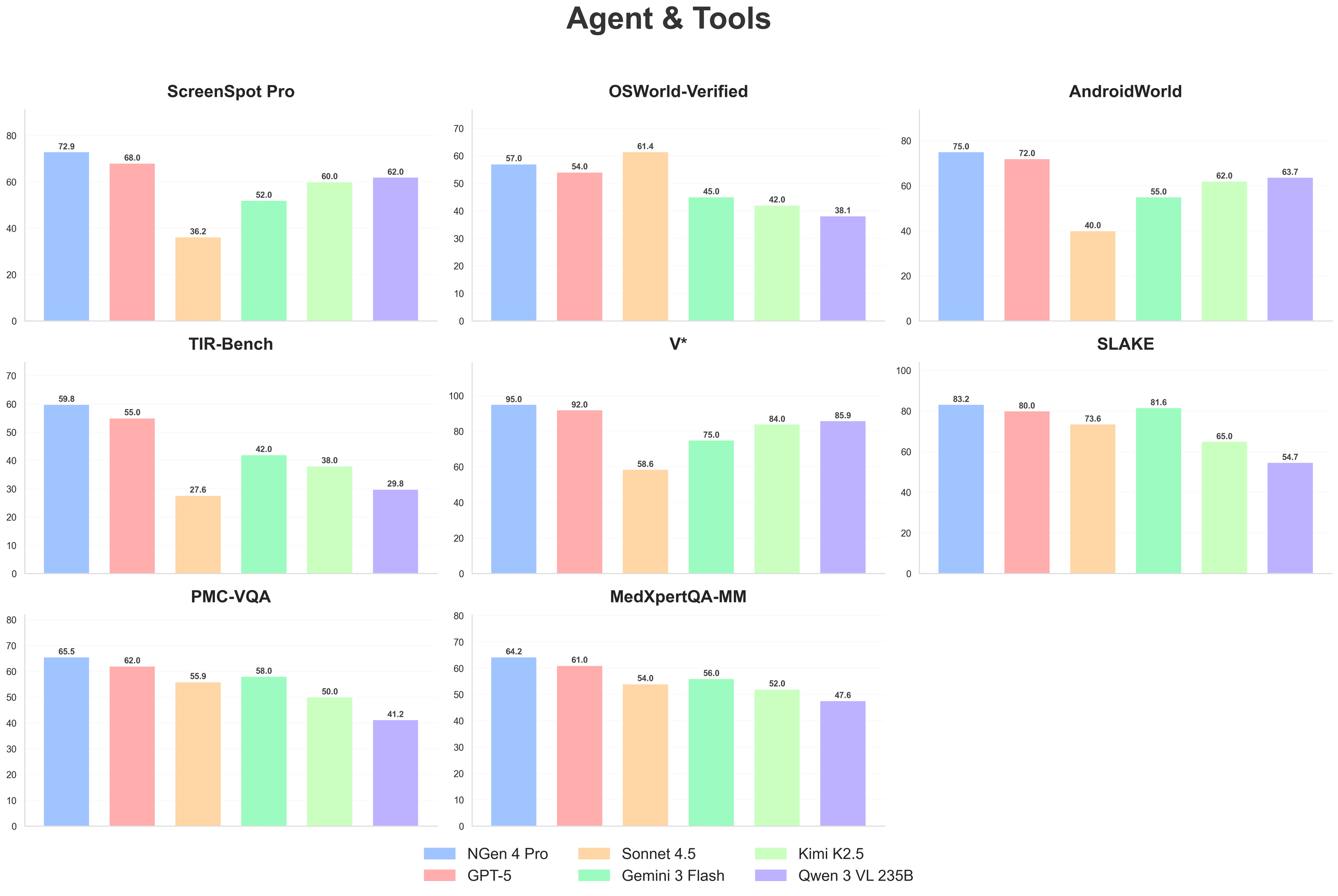
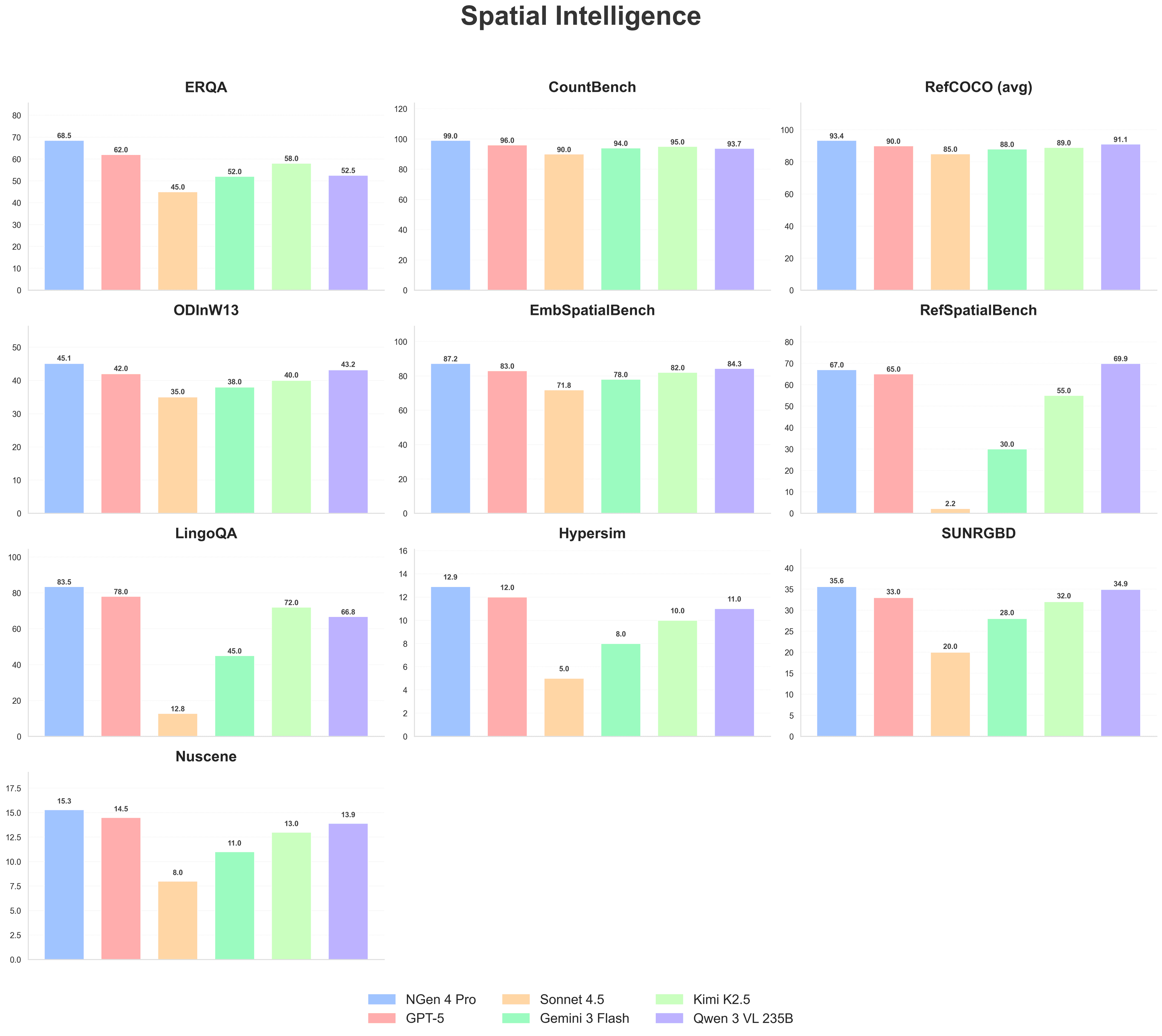
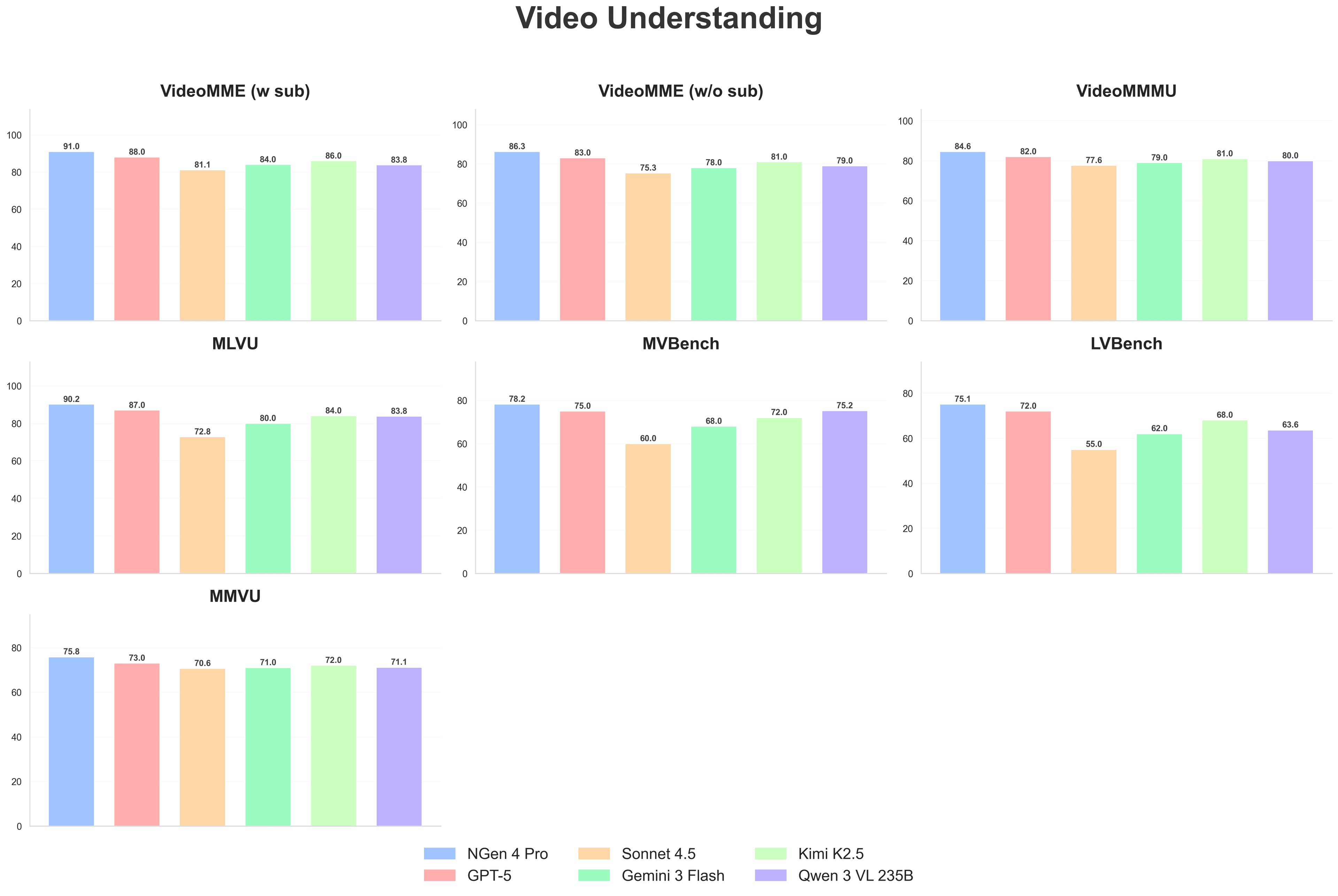
To ensure maximum transparency and cross-industry comparability, TNSA has conducted all performance evaluations for the NGen 4 series using the exact benchmarking protocols established by the Qwen 3 team. By adopting these standardized evaluation frameworks—including identical prompt templates, scoring heuristics, and data contamination checks—we provide a verifiable and objective baseline for NGen 4’s capabilities. This alignment allows users to directly compare NGen 4’s performance against contemporary state-of-the-art models with total confidence in the results.
3.1 NGen 4 Pro Evaluation Results
- Reasoning: GPQA Diamond 90.1, LiveBench 88.5
- Math: AIME 2025 100.0, GSM8K 99.2
- Coding: HumanEval+ 95.1, SWE-bench Verified 72.1
- Knowledge: MMMLU 93.2
- Visual & Spatial: MMMU-Pro 79.3, ERQA 68.5
- Document: DocVQA 96.5, OmniDocBench v1.5 93.9
- Video: Video-MME 91.0
- Agentic & General: BFCL V4 69.9, BrowseComp 64.8, Terminal-Bench 2 42.3, GAIA 60.5
3.2 NGen 4 Mini Evaluation Results
Selected reported points for NGen 4 Mini include:
- HMMT 2025: 76.7%
- Competitive performance against Qwen 3 and earlier GPT variants on advanced math and reasoning tasks
NGen 4 Reasoning & Knowledge
Zero-shot performance of the current NGen 4 flagship series.

Figure 5: NGen 4 Mini: Reasoning, Knowledge, and Logic evaluations.
NGen 4 Engineering (SWE-Bench)
Dedicated Software Engineering performance on SWE-Bench Verified.
Advanced Text & Reasoning
Comparing NGen 4 and NGen 3 series against Qwen3, DeepSeek, and Llama 4.
Logic & Mathematical Reasoning
Frontier performance on AIME 25 and HMMT 25 benchmarks.
Advanced Engineering & Coding
Comparative analysis on LiveCodeBench and CFEval.
Vision & Multimodal Intelligence
NGen 4 and NGen 3.5 series compared with Gemini 2.5 Flash and GPT-5 Nano.
Figure 6: NGen 4 Mini: Software Engineering and Vision capabilities.
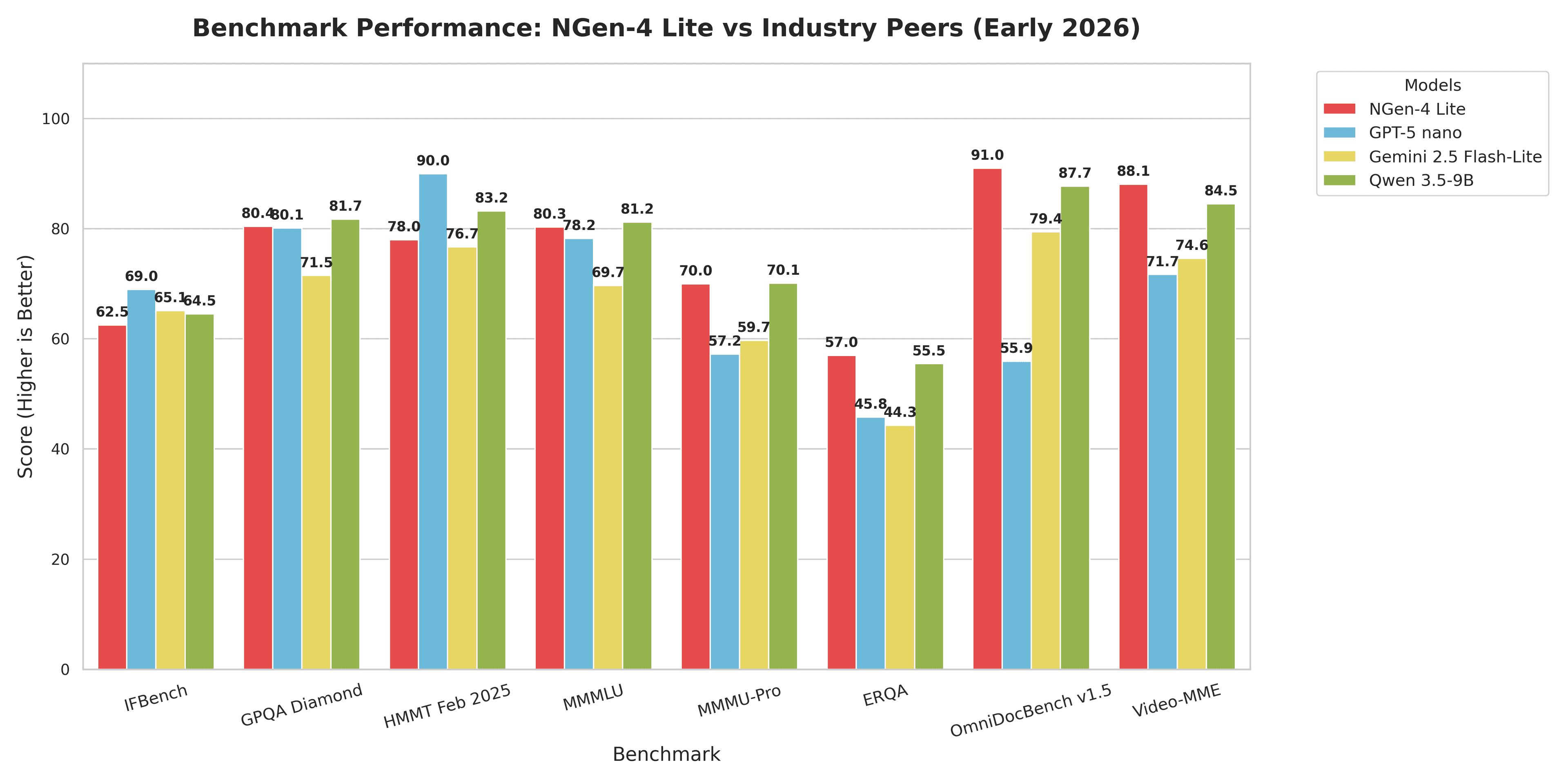
3.3 NGen 4 Lite Evaluation Results
NGen 4 Lite is positioned as the smallest reasoning-capable tier in the NGen 4 family. Detailed benchmark tables for Lite are not included in this document version.


4 Conclusion
4.1 Summary of NGen 4
The NGen 4 series marks a pivotal moment in the evolution of artificial intelligence, successfully bridging the gap between raw linguistic fluency and rigorous logical deduction. By moving beyond the paragraph-style chain-of-thought of the NGen 3 generation and implementing a structured, step-by-step reasoning architecture, NGen 4 has redefined industry standards for factual accuracy and logic-based grounding. The dual-architectural approach—utilizing NGen4Dense and NGen4MoMinMoM—allows the series to scale its intelligence dynamically across the Lite, Mini, and Pro tiers. Validated by world-leading scores on benchmarks such as AIME 2025 (100.0%) and OmniDocBench (93.9%), NGen 4 stands as the premier foundation for multimodal reasoning and complex problem-solving in the 2026 landscape.
Beyond its technical dominance, the series represents a deep commitment to cultural intelligence and safety alignment. Through its proprietary Indic Alignment phase and the implementation of teacher-steered safety protocols to mitigate "Shoggoth" behaviours, TNSA has produced a model that is both high-performing and uniquely responsible. While NGen 4 adopts some syntactical structures from its teacher models to ensure alignment, it retains an unparalleled depth of world knowledge and reasoning capability. Whether deployed for autonomous agentic tasks, advanced software engineering, or regional language comprehension, the NGen 4 series provides a secure, culturally aware, and remarkably intelligent framework for the global future of AI.
2026
Author
TNSA Safety and Models Team
Keep reading
View all
Follow TNSA updates
Explore model releases, research notes, product updates, and company news.